When one door closes, another opens
Rudolf didn’t plan to become a crane technician - he just wanted a job that made sense. After several years in the construction industry, the daily grind of long commutes and vehicle issues began to wear him down. “Most of the construction work was in Helsinki, but I lived in Hyvinkää,” he says. “I didn’t want to keep using my own car - it felt like I was replacing them more often than socks.”
He asked his employer about getting a company car. The answer was no. So, he started searching for something better. One job post caught his eye: a Konecranes recruitment training program. “I applied and got in. That’s where it all started,” he says.
Learning by doing
The transition from housebuilding to crane maintenance might sound like a leap but Rudolf made it work. The six-month training included just enough theory, with a strong focus on hands-on experience. “I’d never seen an industrial crane before,” he admits. “Everything was completely new. But it was designed well - lots of time in the field, just the way I like it.”
Those early months laid the groundwork, but they were just the beginning. “You’ll never know everything in this job,” Rudolf says. “There are so many types of cranes and systems. You keep learning constantly - and that’s what makes it interesting.”
From rookie to service supervisor
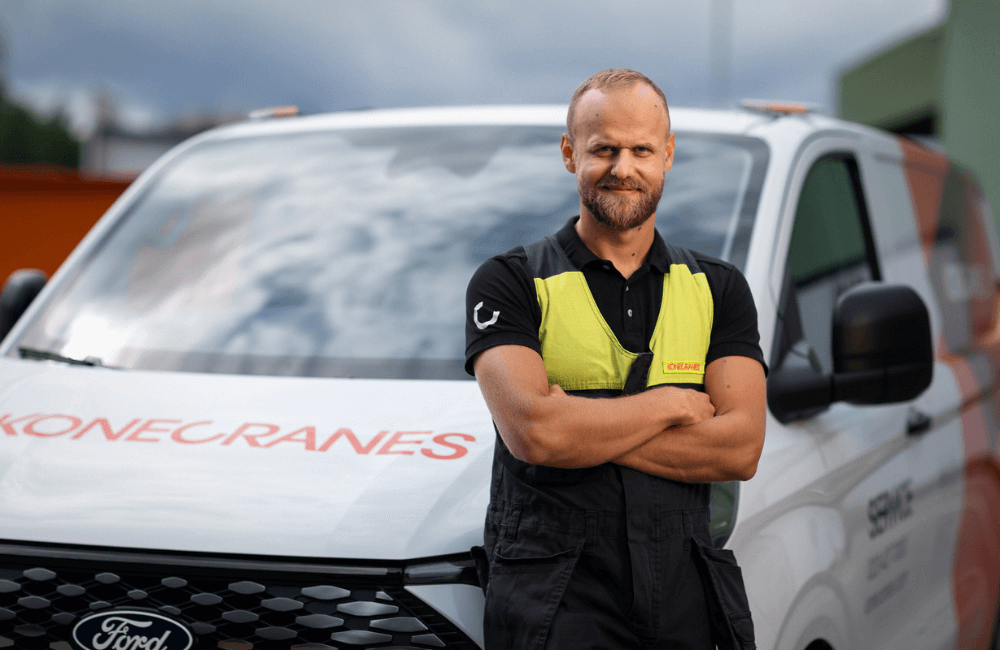
Seven years later, Rudolf is now Service Supervisor in the busy Port of Vuosaari. Most of his work revolves around port cranes - critical equipment that keeps goods flowing in and out of Finland. “About 80% of my time is spent at the port,” he says. “No two days are the same.”
A typical day might include:
- coordinating with customers to schedule work,
- organizing maintenance teams and planning tasks,
- jumping in for hands-on installations or emergency repairs,
- and responding fast when equipment goes down.
“There’s a lot to manage,” Rudolf explains. “But keeping our customers happy - that’s the most important part. If the cranes don’t work, the port stops. And when you fix something quickly, and a customer tells you that you saved their week - that’s the best feeling.”
The pressure is real, and so is the pride
Working in a port isn’t just about machinery - it’s about trust and timing. “We often work at night or weekends when something breaks. There are moments when you’ve just sat down at home, and the phone rings. You grab your tools and go.”
Those calls aren’t easy, but they’re worth it. “The appreciation we get after solving a tough problem makes it all worthwhile,” he says. And when things go well, it doesn’t go unnoticed. “Sometimes our manager or the customer gives us direct feedback - just a simple ‘thank you’ can go a long way,” Rudolf smiles. “We all take pride in doing things right.”
The tools and team work - that keep cranes running
At the heart of every repair job is a mix of skills. Rudolf says common sense is just as important as technical knowledge. “You need to understand basic mechanics, electricity, and how to work safely. But it’s also about knowing how to solve problems in the moment.”
He lists his most-used tools: a screwdriver, electrical meter and good instincts.
Technology has changed the job a lot, too. “Today, we use smartphones and tablets for reporting and even for accessing crane systems. That wasn’t the case a few years ago,” he says. “Even starting up new cranes happens through mobile apps now. It makes the job smoother, but also requires staying up to date.”
Safety above all
Safety is part of everything Rudolf does. “It starts the moment I get in the company car - we follow traffic rules, wear seatbelts. Then on-site, we do things by the book: proper steps, proper tools, and proper protection."
Working at height is also part of the job. “These cranes are tall, and when you’re up there, you need to be secured. We always wear harnesses, helmets, gloves - the basics, every time.”
No one works alone
One of Rudolf’s strongest beliefs is in the power of the team. “In a port environment, you should never work alone. If something happens, you want someone nearby. You have to trust your colleague completely.”
That trust goes both ways. “We work in tight spaces with heavy machines. I need to know that my teammate isn’t doing anything unpredictable, and they need to trust me the same way. That’s what makes the work both safe and enjoyable.”
Why he stays and what he’d do next
When asked what keeps him motivated, Rudolf doesn’t hesitate. “The people,” he says. “Our team, the customers, the conversations. It’s not just about fixing machines - it’s about solving problems for real people.”
And if he weren’t working in service? “Something customer-facing,” he says. “Maybe sales or consulting. I really enjoy the human side of the job.”
For anyone thinking about a career in crane maintenance…
Rudolf’s advice is clear: “Come with an open mind. Be ready for challenges. Be flexible with your time - and you’ll be rewarded.” And the rewards aren’t just financial. “There’s pride in what we do. When a machine starts working again and someone says, ‘Thanks, you saved us’ - you know you’re doing something important.”